
How Foods Are Classified Based on Their Origin (USA)
A simple guide to food labels in the United States
When grocery shopping in the US, you’ve probably seen labels like organic, grass fed, free range, non GMO, natural or hormone free.
These labels can be confusing, and most people buy food assuming they know what they mean. The truth is, many of these terms are either misunderstood or only partially regulated.
Understanding food labels is one of the easiest ways to become more informed about where your food comes from and how it was produced. Once you understand them, you can make choices that better support your gut health, hormonal balance and long-term wellbeing, without stress or obsession.
Antibiotic free
In the United States, antibiotics can be used in animal agriculture, both to treat illness and, in some systems, to prevent disease.
When you see antibiotic free, no antibiotics ever or raised without antibiotics, it generally means the animal was not given antibiotics at any point in its life. This label is more commonly used on dairy products, but variations exist on meat products as well.
If antibiotic exposure is a concern for you, transparency from the producer matters more than the label alone.
Cage free
Cage free means poultry were not kept in cages.
What this label does not guarantee is outdoor access. Cage free birds may still be raised indoors in crowded conditions. This label is most commonly used for eggs.
If access to pasture and animal welfare matter to you, look for pasture raised instead.
Conventional farming
Also known as industrial agriculture.
This system relies heavily on synthetic fertilisers, pesticides and herbicides to maximise crop yields. It may include monocropping, genetically modified organisms, confined animal feeding operations and chemical weed and insect control.
Conventional farming supplies the majority of food in the US.
Free range
In the US, free range means animals must have some access to the outdoors.
There are no strict requirements regarding the amount of time, space or quality of outdoor access. Because of this, free range can vary widely in practice and does not always reflect higher animal welfare.
GMO free / Non GMO
GMOs are plants or animals that have been genetically modified using DNA from other species.
In the US, genetically modified crops are common, especially corn, soy and canola. Products labelled non GMO or GMO free have not been genetically modified.
This label is particularly relevant for processed foods and packaged products.
Grain fed
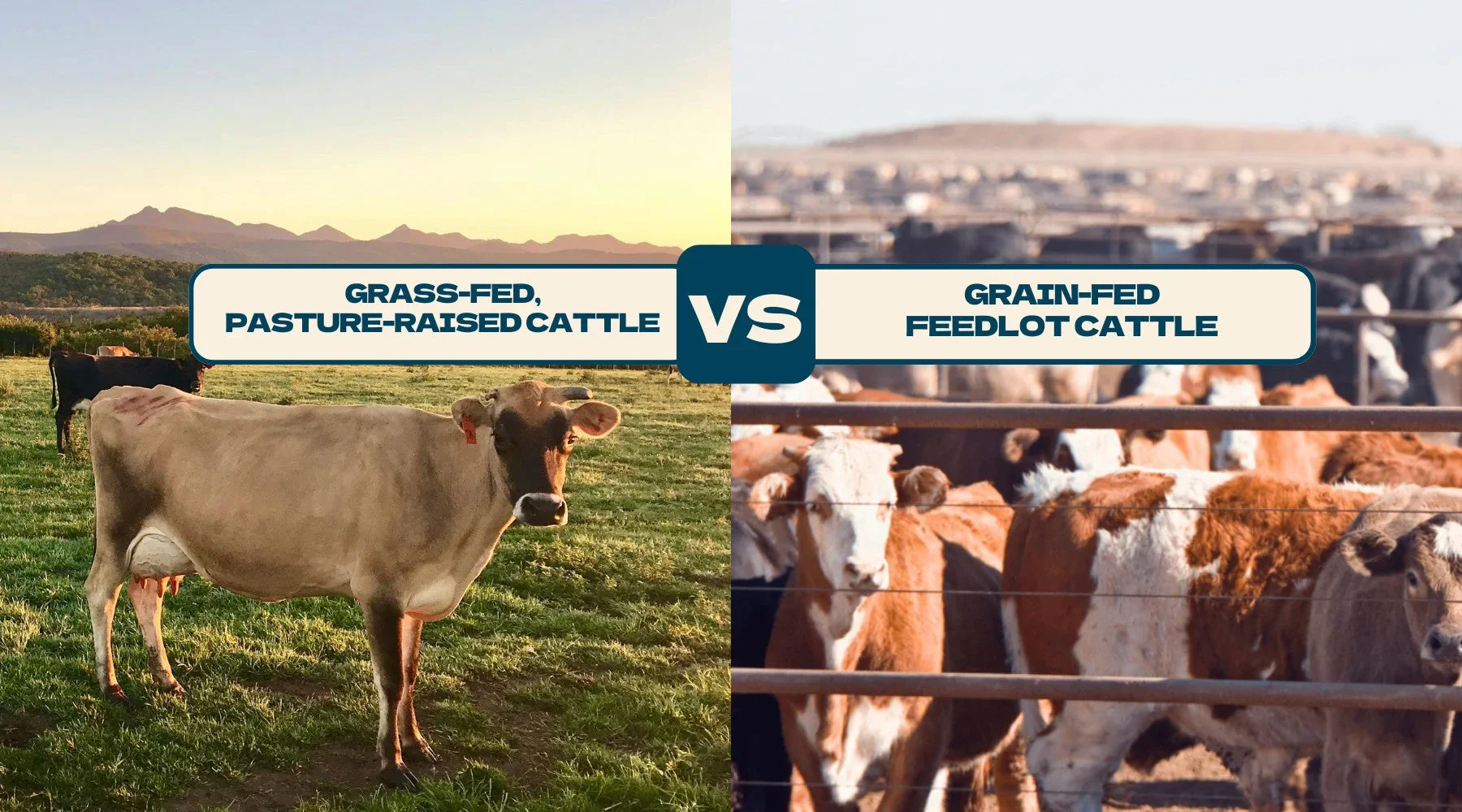
Grain fed animals are fed grains during part or all of their growth, often in feedlots.
This diet produces meat with more marbling and a whiter fat color, which is often associated with tenderness and flavor. Grain feeding is common in US beef production.
Antibiotics and growth hormones may be used, depending on the production system.
Grass fed
Grass fed means animals were fed grass instead of grains.
Grass fed meat is generally leaner and lower in fat and calories. However, grass fed does not always mean lifetime grass fed. Some animals may be grain finished before slaughter unless the label specifies otherwise.
Pasture raised
Pasture raised indicates animals were raised outdoors on pasture and allowed to graze freely.
This label gives a clearer picture of animal welfare and natural living conditions compared to cage free or free range. While widely used, it is not strictly regulated.
Hormone free
Growth hormones are permitted in US cattle production but are banned in poultry and pork.
A hormone free label on beef can therefore be meaningful. However, on chicken and pork, this label does not indicate a difference, as hormones are already prohibited by law.
Local
Local generally refers to food produced close to where it is sold, although there is no strict legal definition.
Local food can be organic or conventional and may or may not be non GMO. It is often fresher, travels less, and offers more transparency about farming practices.
Natural
The term natural has very limited regulation in the US.
For meat and poultry, it means the product is minimally processed and contains no artificial ingredients. It does not mean organic, hormone free, antibiotic free or humanely raised. For most foods, it is primarily a marketing term.
Organic
In the US, organic certification is regulated by the USDA.
Products with the USDA Organic seal must contain between 95 and 100 percent organic ingredients. These products must:
🌱 Avoid synthetic fertilisers, pesticides and sewage sludge
🌱 Prohibit GMOs and irradiation
🌱 Use soil building and conservation practices
🌱 Provide animals with outdoor access and, where applicable, pasture
🌱 Avoid antibiotics and growth hormones in animals
🌱 Feed animals 100 percent organic feed
🌱 Prevent contamination during processing
🌱 Maintain detailed records and undergo regular inspections
Products with 70 to 95 percent organic ingredients may state made with organic ingredients on the front of the package. Products with less than 70 percent organic ingredients may only list organic ingredients on the side panel.
Organic foods also prohibit hydrogenated oils and trans fats.
Fair Trade
Fair Trade applies mostly to imported foods such as coffee, chocolate and bananas.
It indicates farmers and workers were paid fair wages and worked under acceptable conditions.
Heritage
Heritage refers to rare or traditional breeds of animals or crops.
While not legally regulated, heritage foods are valued for flavor, genetic diversity and traditional farming methods.
A final reminder
Food labels are tools, not rules.
They’re meant to guide you, not overwhelm you. Once you understand what these labels actually mean, you can choose food that supports your health in a calm, grounded way, without falling into fear or perfectionism.